Off Campus and the unified theory of how the Pre-Raphaelite Brotherhood picked my haircut in 1848
For the last few weeks a certain segment of the internet has been abuzz about Off Campus, the latest hockey romance from Prime Video. I watched it; it's sweet. It nicely threads the needle between its two target demographics of Millennial women who read the book series the show is based on, and Gen Z women who recently learned that hockey players can be hot and gay and thought they'd give the straight ones a try too. It handles some heavy themes well, and weaves in the deep platonic friendships that make a romance story feel lived in. My only real complaint about it, as the 20-year partner of a former college hockey player, is that if a whole hockey team lived in a house together that house would smell like perpetual wet fart in an irreparable might as well burn the house down and rebuild kind of way and no girl would want to spend time there even if all the residents were hot and sensitive and one of them cooked. I'm just saying.
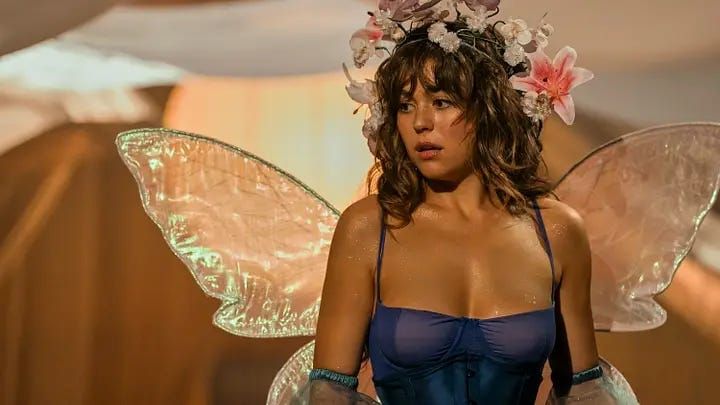
Arguably, the breakout star of the show is Mika Abdalla as Allie, the best friend of the female main character. Allie's romance will be the subject of the next season, and is teed up as a subplot throughout the premier season. She gives a layered, engaging performance as a college girl who's going through it having just confronted for the first time the idea that the expansive, creative life she wants and the milquetoast boy she loves might not be compatible in the long run, and that the friction of the unknown might be more, uh, shall we say satisfying. (Satisfaction in this case coming in the form of a tall blonde hockey player.) She's kind, empathetic, loving life, and looking hot while doing it in a costume design by Charlene Akuamoah that's equal parts TikTok trend and items liberated from the theater department closet - as would befit a college actress like her character. Like her character, her closet (and hair) refuse to be less than A Lot. Lots of women saw something of themselves, or something they want for themselves, in her.
There's been a flurry of activity identifying the makeup, wardrobe pieces, and hair products used for her character. Her hair in particular, designed by Debra Wiebe, has caused a bit of a stir among certain brands of women, and clearly a lot of them went to immediate lengths to pursue its perfectly voluminous, messy but stylish effect. If you search "Off Campus Allie" the next recommended word is "haircut." I did not have to google Allie's haircut - not because I wouldn't; this is not that kind of post, I am exactly like all the other girls - because I already have this haircut and have for years. It's a long shag. It definitely doesn't look as good on me, but it does capture the vaguely artsy, unkempt but not too messy for work, "you can't tell me what to do vibes" that I like to cultivate. I probably have this haircut because Florence Welch had this haircut when I was a college girl trying to figure out my life. She probably had this haircut because a long line of lady rock stars with witchy energy have had this haircut. Stevie Nicks, eternal queen of witchy rock energy, had this haircut.
The shag, the shorter original, is widely considered to have been originally popularized in the late 60s by the OG darling of you can't tell me what to do energy, Jane Fonda. It's the hair cut she has in her iconic mug shot. Both women and men, David Bowie would famously also rock a shag in the 70s, were rebelling against the strictures of a highly gendered, highly coiffed post-war society in which women's hair was typically teased and hairsprayed into exaggerated shapes, and men's was tamped down with Brylcreem. The layers of the shag allowed natural hair texture to create volume, but without the contrived quality of a teased style, and unlike the frozen hairsprayed-to-hell stalwart styles of the day it allowed for organic movement. The done but undone look fit perfectly into the style of the alternative set of the time: unprocessed, unfussy, embracing natural textures in both hair and clothing. By the time Stevie Nicks was hitting the stage in a long shag in the late 70s, it had morphed into something in between: natural hair texture but teased to maximum volume. The rebelliousness and refusal to conform of the late 60s mixed with the aggressive femininity of the early 60s, plus a little extra unapologetic glam of its own. The perfect signature style for the poster girl for 20th century Bohemian style and women unapologetically being A Lot.
Style, like history, rarely exactly repeats but nearly always rhymes. Bohemian style influences ebb and flow throughout fashion history alongside the rise and fall of anti-establishment sentiment. The stylistic signals of the Hippie movement of the late 60s were echoes, intensified by the anti-war movement and an increasing sense of global consciousness among young Americans, of the Beat Movement of the 1950s. The John Waters cult classic Hairspray, the inspiration for but not to be confused with the much more bubblegum musical of the same name, set in 1962, parodies the association of political radicalism and beatnik styles in a brief scene in which Pia Zadora and Ric Ocasek play beatniks who, assuming that they're fleeing "the fuzz," hide the protagonists in their garden apartment. "I'm an integrationist; we shall overcome!" the heroine, Tracy Turnblad, asserts. "Not with that hair, you won't," beatnik Pia quips. She expounds on the benefits of drug experimentation and ironing her hair to achieve a more silky, flowing style in contrast to the immovable monument to the eponymous substance the heroine is sporting. Eventually she chases them out of the apartment shouting lines from Allen Ginsberg's "Howl."
Like their Beat predecessors, the Hippies drew inspiration from global influences, particularly eastern religious iconography and ideas, Latin American folk revival style references, and burgeoning Pan-Africanism. Although this piece primarily traces the roots of white women's hair and fashion influences - I am wholly unqualified to talk about Black hair with appropriate nuance and would point instead to a plethora of very cool sources by Black historians - I would be remiss if I didn't point out the relationship between the natural hair movement and Black liberation style and what would become the hallmarks of the Bohemian style as we know it today. It's hard to imagine Stevie Nicks teasing her hair for performances in 1977 if high volume styles had still been associated with the cultural repression of the early 1960s, the teased styles that Pia Zadora calls "very uncool," rather than Black pride, political radicalism, and icons of Black visual culture like Pam motherfuckin' Grier. The history of Black Bohemian culture and style is rich and complex in its own right and doesn't necessarily rely on the same visual language as comparable white style movements, though there is certainly dialogue between them in the 20th century and beyond. Likewise, white Hippies were heavily influenced by the visual language of the early 20th century Latino Arts Movement, and the political activism and pride movements of Latino and Asian farmworkers particularly on the west coast - the epicenter of Hippie cultural influence.
Looking to "the other" for answers didn't begin with the Hippies or the Beat Generation. In the late 19th and early 20th century, American artists, thinkers, and left-leaning young people on the fringes of society were looking elsewhere for answers. D.T. Suzuki, possibly the single most influential figure in popularizing Zen Buddhism in the West, arrived in the United States in 1897, having been invited by publisher Paul Carus, himself a German immigrant, who became fascinated with Buddhism after reading a paper translated by Suzuki for the 1893 Parliament of Religions. The Parliament of Religions was the first gathering of what would eventually become the global interfaith movement. While the goals of the gathering, summarized by Swami Vivekananda, the representative of Hinduism who gave the opening convocation stating, "I fervently hope that the bell that tolled this morning in honor of this convention may be the death-knell of all fanaticism, of all persecutions with the sword or the pen, and of all uncharitable feelings between persons wending their way to the same goal," were perhaps not fully realized, to put it lightly given the oncoming conflicts of the 20th century, the gathering opened the door for the Zen writings that would so profoundly influence Jack Kerouac and the Beats.
The relationship between fringe political movements, Bohemian style, and foreign influence goes back to the origins of the term. In 19th century France, La bohème was used to refer, often derogatorily as has so often historically been the case, to the Romani people, who were erroneously believed to have arrived there from Bohemia in the modern day Czech Republic. Over time it evolved to mean anyone living outside the bounds of regimented society in any era from 19th century Paris to late 20th century Alphabet City. It is strongly associated with the visual iconography of artists, immigrants, and the idealized working class, though it typically connotates someone who is not working class but pretending to be for artistic purposes. In fashion, Bohemian style denotes rich textures, saturated natural tones, fluidity and movement in both fabric and hair, and global costume references like heavy embroidery, loose silhouettes, and beading. It frequently rises in popularity as a response to what the artistic fringe feels is an overly structured, rigid, repressive society. This, too, has been true since its inception.
In 1848, three British students at Royal Academy art schools, Dante Gabriel Rossetti, William Holman Hunt, and John Everett Millais, founded a group with the goal of bringing what they saw as the more superior, purer elements of the Renaissance style back to the art world. The Pre-Raphaelite Brotherhood, named for the era they sought to reclaim, felt art should be both truthful and beautiful and that there was truth in beauty. They were disturbed by mass industrialization, increased urbanization, and the poverty, exploitation, and social upheaval that accompanied these massive rifts in the previously largely rural and agrarian British way of life. They aimed to imbue their works with a Christian morality that placed natural beauty and order, truth in imperfection, and pushing against what they saw as the corruption of their historical moment above technical perfection. Despite being explicitly based in Christianity and its mores, the Pre-Raphaelites were heavily influenced by the increasing cultural traffic between East and West as a result of Great Britain's expanding imperialism, and later newly opened trade with Japan. William Holman Hunt in particular traveled extensively in the Middle East and the visual influence of the region can be seen clearly in his works and the features of their subjects. This cultural exchange, of course, was limited in its scope by Orientalism - European attitudes holding anything foreign at arm's length and interacting with it primarily through appropriation of its cultural artifacts.
Despite this cultural exchange, or perhaps more accurately because of the Orientalist nature of it, the Pre-Raphaelites are best known for their paintings of white women. Even if you didn't previously know the history of the Pre-Raphaelite movement, the style will be instantly familiar to you. These women are pale with clear skin and rich toned thick, loose, wavy or curly hair. They are often wearing exquisitely rendered draped clothing in rich colors, and are depicted in nature, or within intimate, textured interior surroundings. The subjects of these paintings were often modeled after women in the movement itself. Possibly the most famous of these paintings is John Everett Millais's "Ophelia," for which Elizabeth Siddall, Dante Gabriel Rossetti's wife, posed. Jane Morris, herself a textile artist of the Arts & Crafts Movement, modeled for, and had relationships with, several of the Pre-Raphaelites. While they did not achieve the type of "It Girl" celebrity fame the Bohemian style would ultimately be associated with, their images continue to resonate through art and culture. The inspiration of their imagery is clearly visible in the 2021 Gucci Bloom campaign starring modern Pre-Raphaelite (and my perpetual personal hair inspo), Florence Welch, and in countless iconic street style moments.
While Bohemian fashion, or "boho" as the fashion industry likes to abbreviate as you might be able to tell from the street style links above, never fully falls out of favor among a certain set - politically leftward, creatively inclined, strong dislike of hard pants and putting any effort into styling their hair daily (ahem: me) - it tends to pop up as a trend when society is undergoing structural stressors due to technological changes. When the world seems to be evolving too fast, it gets more appealing to put on a peasant blouse, let your hair texture do its thing, and maybe spend some discretionary income on some beads and a burnout velvet kimono. On a deeper level, it gets more appealing to seek answers that are more rooted in the concept of "the other," whoever is not currently in charge. Concepts like the divine feminine, eastern philosophy and religion, and global tradition ranging from Eastern Europe, to Asia, Africa, and beyond, are repeatedly integrated into hegemonic mainstream culture in these moments. Some of this is appropriative, assuredly, but some of it comes from a genuine desire to use moments of increased trans-cultural exchange fueled by the technological changes themselves to find new solutions to the modern problems of exploitation and strife. The Pre-Raphaelite Brotherhood was reacting to the industrial revolution, the Beats were reacting to the embedding of the military industrial complex in civilian society, the Hippies were reacting to, well, everything going on in the 60s and 70s, the first and second waves of early 2000s boho were reacting to rapid globalization followed by the global financial crisis.
Through this lens, it seems like we might be about due for a big boho moment. Encroaching data centers, frequent climate disasters, attacks on the centers of the entire fabric of centuries of the enlightenment movement in the form of defunding arts and sciences, the relentless pressure to optimize every facet of daily life - there's a steady beat of threat coming from an increasingly technologized and regimented society. Sounds familiar, right? It's hard, though, in the age of fast fashion, to see a style trend as the vanguard of a revolutionary moment. Any trend can be coopted by capitalism just as fast as it surfaces on TikTok. But I think a couple of interesting things are happening right now: for possibly the first time in modern history, the technological change is coming for the culture makers first. Rather than being a vessel for a bourgeois commentary on upheaval that is happening to someone else, the white collar cultural commentator is at the center of the current automation controversy. How does the creative class react when its position in society is under siege? How does it signal its discontent? Particularly how does it signal its discontent when many of the hallmarks of its usual visual language of reaction, the free flowing hairstyles, the natural fabrics, the centering of the connection between the feminine and the natural world, are currently coopted by the political right in the form of "tradwife aesthetic." It poses a bit of a style evolution logjam.
However, people are finding ways to express this tension. I recently started following Ali Ambrose, a creator with an art degree who offers tutorials in "anti-iPhone face makeup," including one on the Pre-Raphaelites. It's possible that the signals of the Bohemian revolution of our era are more behavioral than stylistic. We're seeing an increase in thrifting, neighborhood "buy nothing" boards, and other forays into the circular economy. More and more people are "friction-maxxing," or finding ways to cut the digital middle man out of tasks that they were previously outsourcing or only performing through the mediation of digital distraction. There is a nascent movement against anti-aging treatments and for the idea of allowing the ultimate optimization canvas, one's body, the freedom to exist without alteration. Choosing the more frictive option in life and opting out of the ease of an automated life, like our girl Allie from Off Campus, increasingly, is a Bohemian activity. Ultimately, she's a fictional character and we can project anything we want on her and her long shag. But I choose to see her as a link in a long chain of cultural artifacts that tell me change is coming. Regardless of how the visual language of the next Bohemian moment evolves, I probably won't be giving up my wavy bangs or my velvet kimonos.
Member discussion